Jun 14 2009
SOLD on the First Lewis River Test Run.

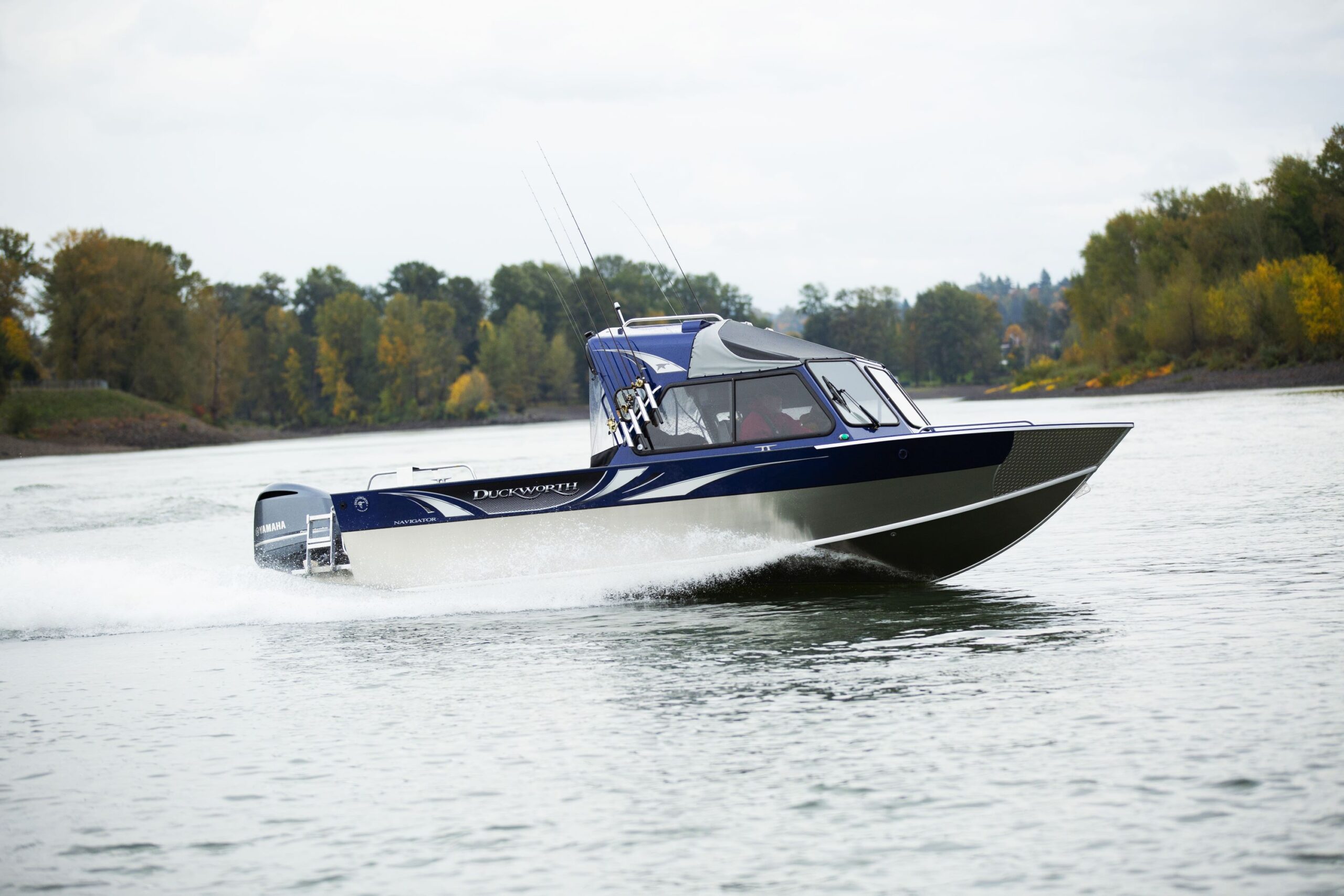
Following several more tests on the Pro 7’s home water, the Snake River, the boat was shipped to Pacific Boatland in Vancouver, WA. The dealer already had several prospects interested in seeing if this new Duckworth was in fact the “missing link” among the current offerings for open tiller sleds. A prominent local guide was among the interested parties and we were anxious to get his verdict on the performance.

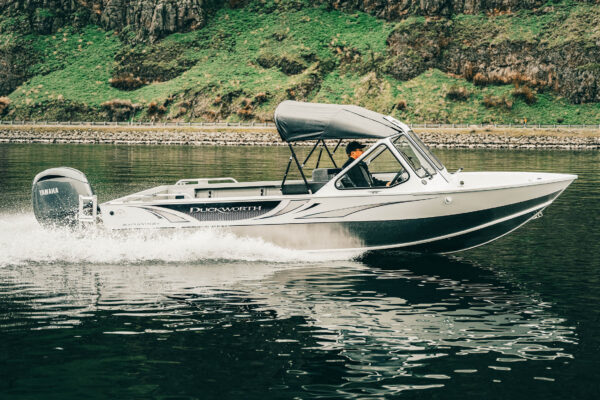
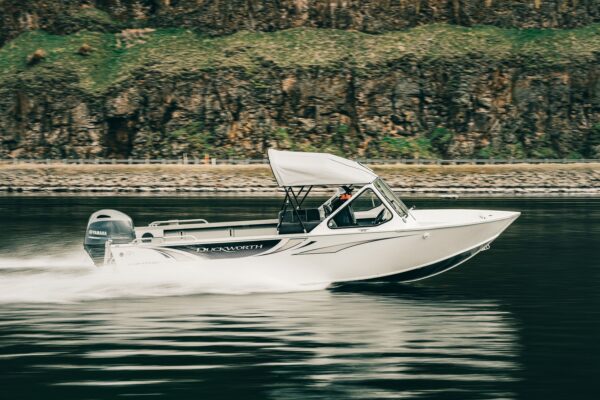
Duckworth Pro 7 Lewis River test run

Duckworth Pro 7 Lewis River test run

We hit the Lewis River and with five people in the boat proceeded to give the Pro 7 an authentic run through all the potential scenarios its eventual owner would be subjecting it to. At the tiller was a guide who knew every seam, tailout and backchannel of the river, and we ran through all of them. We backtrolled in every type of current, from swift and straight to squirrelly and hydraulic.

Duckworth Pro 7 running the backchannel

The boat held the line with perfection. We ran some shallow spots but had to play it ultra safe on account of the boat being brand new. The consensus was, even with five people on board, we weren’t taking on any more than five inches of draft…probably less. We drifted back in some tailouts that were less than a foot deep and full-throttled our way out with almost no bow rise or squatting coming on to plane. The boat provided an extremely level take-off out of the hole. To recap, this Pro 721 (7’ wide bottom x 21’ length.) had a 150 ETEC motor, 8 hp Yamaha kicker, five people and around 42 gallons of fuel.

Pro 721 Backtrolling for Lewis River Spring Chinook

Pro 721 Backtrolling for Lewis River Spring Chinook

After the test runs, a few other avid anglers joined in for a lengthy “tire-kicking” session. Everyone agreed the thickness of the gunwale at the bow was too wide. They needed to be reshaped to gain more floor space and a sportier look. The sliding seat brackets were a big hit, as was the split fish box and storage compartments.

Duckworth Pro 7 seat slider system

Duckworth Pro 7 seat slider system

Duckworth Pro 7 Transom

Duckworth Pro 7 Transom

The biggest debate centered on the side flair and beam. As it was, this first Pro 7 had a 7’ bottom and 8’ beam. This provided the perfect interior vertical stance for angling. You could stand right against the gunwale with your toes under the lower rod tray and lean only about 8-degrees out before your thighs comfortably rested against the gunwale.

Duckworth Pro 7 interior stance angle.

Duckworth Pro 7 interior stance angle.

In everyone’s opinion, that was optimal for interior functionality. However, it was the external look that seemed to catch many with uncertainty. The side flair was minimal, about 12-degrees, so while it worked well on the inside, it gave the boat a somewhat boxy look from the outside. There was the usual “if this, then that” debates that went on and on. It was precisely the candid feedback we were looking for from this influential group.
In the end, while being a major redesign, the decision was made to expand the beam another 6” to 8-1/2 feet or 102.”  This would place the Pro 7 in the coveted position of having the widest bottom width in its class, as well as nearly the widest beam. The change would not affect the dynamic performance of the bottom much, if at all. Certainly some would say, “why not just go 104 and be the widest?” The answer comes back to that critically important vertical stance on the interior. The wider the beam, the wider the side trays and/or gunwale would have to become in order to prevent an imbalanced stance. Any width over 102” would require anglers to brace themselves with their hands or risk their feet flying out from under them and potentially going overboard. We all know it takes two hands to fight and net fish effectively.

Throughout the test ride and subsequent discussions, one individual in the group had seen everything he needed to and purchased the boat. A little rigging and it was gone a few days later.

Pro 721 number 2 and 3 in production now.


Jun 4 2009

First Float a Success!

Expectations were exceeded on the first float and test run of the Pro 7. From computer screen, to CNC cutter, to the fab shop floor, and now on the water, the Pro 7’s first bath went off without a hitch.

Duckworth Pro 7 ETEC

Duckworth Pro 7 ETEC

The dock looked like the front row of an NBA finals games with seconds to go. The crew stood anxiously as water hit the hull for the first time. A big sigh of relief when the motor fired up on the first crank. A second big sigh once the Pro 7 left the support of the trailer and floated level with just one person in the back.

Level floatation, buoyancy and balance were the primary tests for the first run. The 42-gallon, in-floor fuel take had 20 gallons of fuel or about 160 pounds. The tank was not permanently secured so that it could be moved forward or aft to achieve the desired weight distribution.

The Pro 7 was run with a single driver, then two passengers and then three passengers. Weight was shifted from port to starboard at rest and on plane. Even with all three people on one side, the wide 7-foot bottom performed exactly as designed, leaning very little.

Duckworth Pro 7 on plane with bow load

Duckworth Pro 7 on plane with bow load

To simulate different loads, two battery boxes full of lead we’re placed far forward, on one side and completely aft. Regardless of where the weight was positioned, the Pro 7 came out of the hole with ease. In fact, the difference in bow rise with the added weight all the way forward and all the aft was negligible. We were all pleasantly surprised that a boat of this size with a 150 E-Tec outboard mated to a jetdrive would come on to plane in about a boat length and a half.  Equally surprising was how well it accelerated and easily it ran with what would generally be considered “moderate horsepower” for a ride of this size. The lack of bow rise means this boat will be able to tempt shallow tailouts and beat feet without hitting bottom. Can’t wait until our river trial.

The boat was put through a series of turns at various speeds to measure tracking and handling. The addition of six proprietary solid extruded cupped planning strakes gave the “ride on rails” performance we expected. Not even the slightest sliding or skip was detected even in the sharpest high speed turns. I wasn’t too sure what to expect with this new straking system Duckworth’s developed but now I’m honestly impressed with what is no doubt a real innovation in welded aluminum boating.

With all the measurements in hand, the Pro 7 returned to shop for a few final tweaks and securing of the fuel tank at midship. On the next test run we go looking for swifter current and shallow water to see how the Pro 7 handles in her native environment.


May 22 2009

Motor Selected for the New Pro 7

With the first hull complete and ready for testing, the development teams anxiously awaited arrival of the motor. And waited… and waited… and wondered if it would ever come.
Many discussions were had early on as to the best power plant setup for Pro 7. Having the OEM resources from Yamaha, Honda and Mercury provided virtually every option. With cost, fuel efficiency, power to weight ratios, and reliability all major factors, one of Duckworth’s prominent dealers requested the team try the new E-TEC motors from Evinrude. E-TEC outboards require no scheduled dealer maintenance for the first three years or 300 hours of normal recreational use. Not even gearcase lube. You’ll never have to change the oil or the oil filter, which can cost several hundred dollars each year for other technologies.
Since the first Pro 7 would likely be sold by Pacific Boatland in Vancourver Washington, the decision was made to order a 150 hp tiller E-TEC with jet pump.

It was nearly a month before the motor and rigging parts arrived at the factory in Clarkston. The truck hadn’t even left the yard before the motor was uncrated and tools started turning. By early afternoon the long awaited maiden voyage was reality. Off to the boat ramp with high expectations in tow.


Mar 25 2009

Duckworth Has Done It All Before. Can They Do It Again?

If you’ve been a hard-core angler for more than 30 years this will come as no surprise. If you’re not, it likely will be.

Duckworth has manufactured open-style boats since the late 1960’s. No doubt many of them are still on the water today bonking their fair share of fish. The heydays of the open boat excitement began in the mid 80’s when the Pro-Steelheader models first emerged.

The Pro-Steelheader was custom built for the largest independent dealer of the times, Nixon’s Marine. In fact, most of the earliest models did not even have the signature Duckworth logo on the side. The model was offered in an open tiller style, center console and windshield versions. The quality was exceptional and years ahead of competitors. Unique angling features, designed by several prominent guides of the times, drove sales in a one-way direction—up and up. For many years, demand outpaced production and scores of orders awaited their place in the assembly line.
This version of the Pro-Steelheader built by Duckworth was the original namesake. The name was trademarked at the time but has since expired and is now being used by several other manufactures. (Unfortunate, but true.)
In the 1990’s, production capabilities at Duckworth grew and another equally capable open boat was designed, first and foremost to suit the demands of Alaska’s most prominent fishery on the Kenai River. Aptly named the Kenai model, it was offered in lengths of 16, 17 and 18 feet with a 66” bottom and 26” sides.
dw-1997-18-kenai-wolfe

dw-1991-16-kenai-honl

During the mid 1990’s, you would have been awestruck by the number of boats competing for the world’s largest salmon. Amongst the rowboats, jon boats, bathtubs and flat bottom sleds, undoubtedly you would have seen dozens of Duckworth Kenai models. The same would also be true on most popular rivers in the west coast.
The Kenai model was created to run the Kenai River which had horsepower limitations for the outboard motors of 35hp. All tolled, Duckworth built approximately 250 open boats. The last open Kenai was produced in 1999 and the last windshield Kenai rolled off the line in 2000.

Duckworth Kenai Tiller Duckworth Kenai Center console

During the same period, Duckworth also built a Pro I, Pro II and Pro III series of boats – the Pro I was the open version, the Pro II was center console, and Pro III was a windshield version. These models were available in 17, 18, and 19 feet versions. A handful were custom designed for professional guides and carried the “Silverwing Guide” moniker. The Pro series was later renamed the Discovery Series. In 2001 the Discovery Series was replaced by the very successful Advantage series of boats that continues on today, but in windshield versions only.