Jun 18 2009
How did the Pro 7 do that? Cupped Planing Strakes™ That’s How!

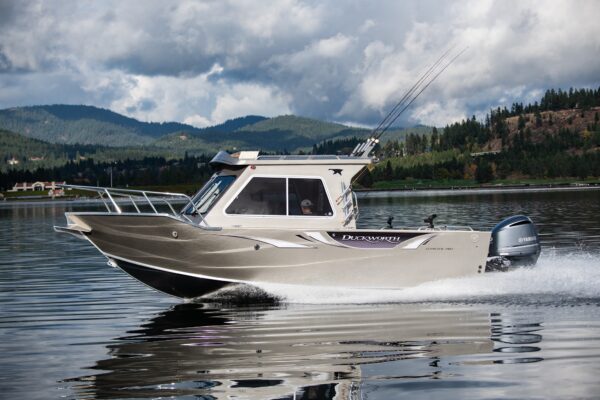
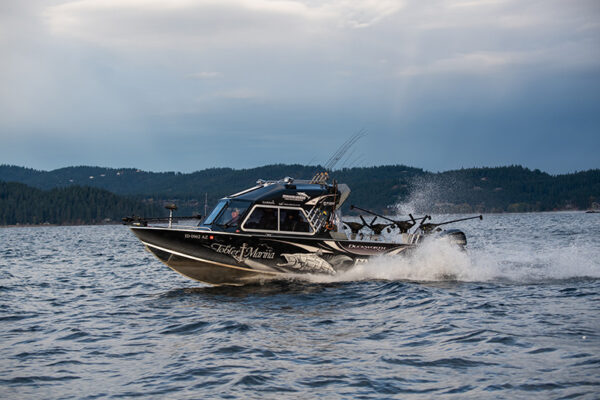
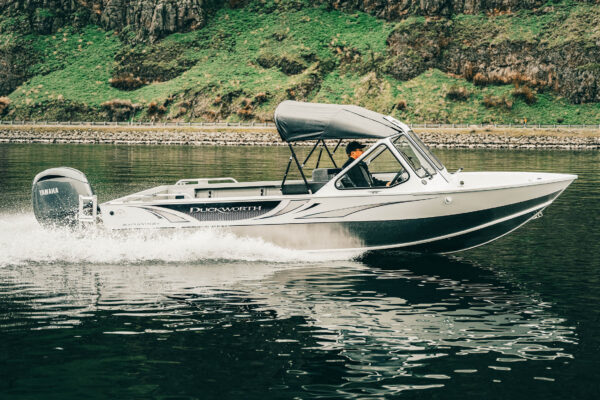
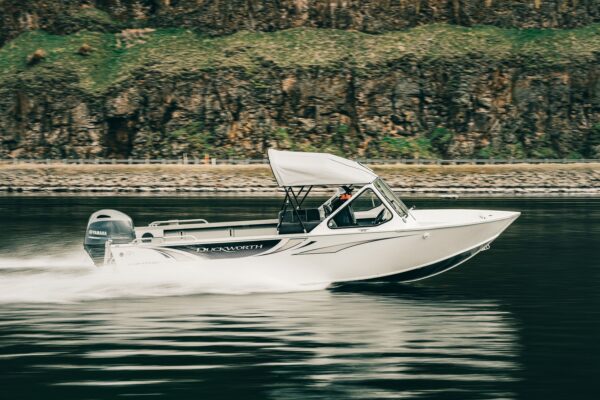
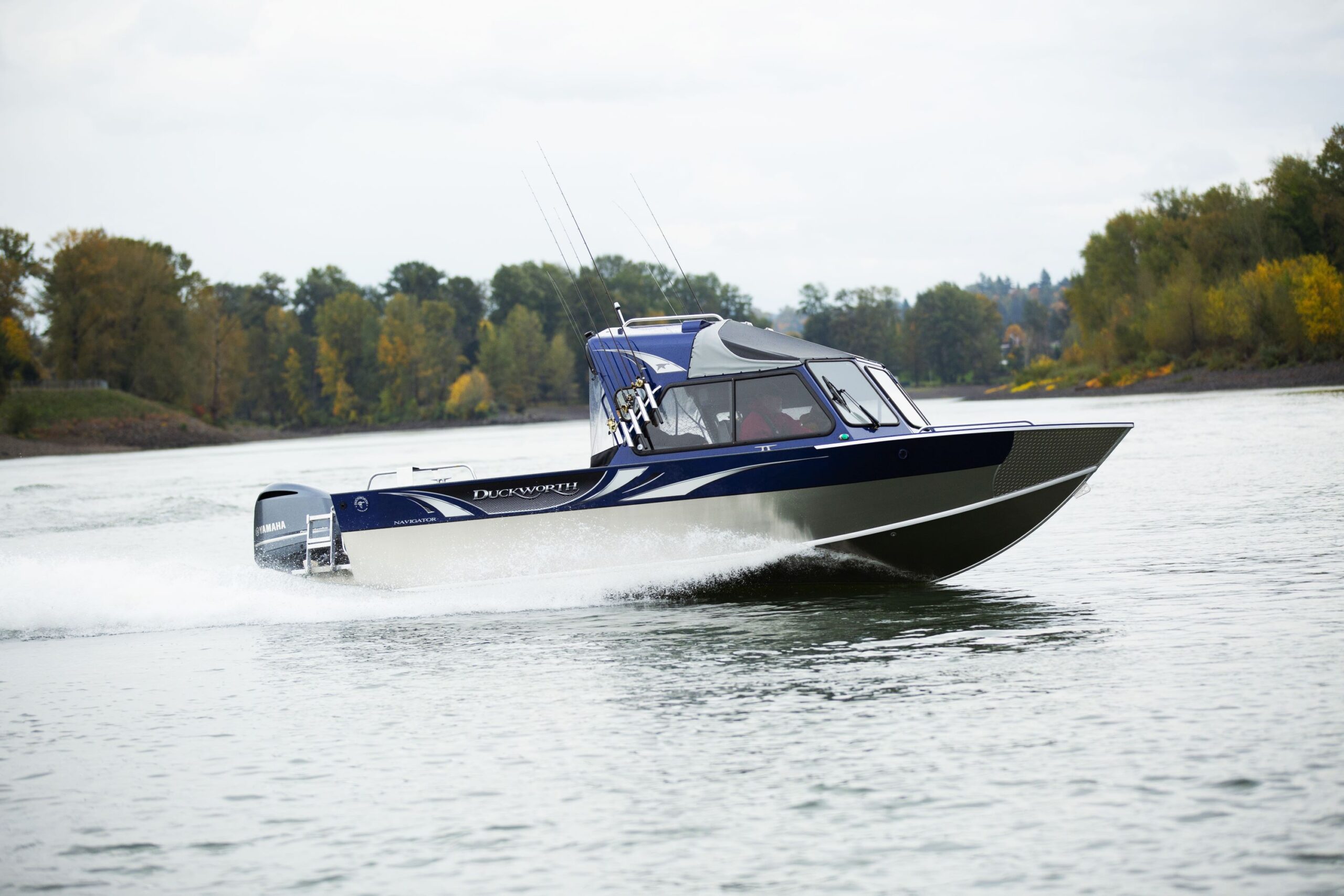
The Pro 7 tracked perfectly straight, came out of the water effortlessly, and didn’t produce the slightest tendency to want to slide even during aggressive high speed cornering.

The exclusive “Cupped Planing Stakes” are a big reason why.

Duckworth Pro 7 Cupped Planing Strakes™

Duckworth Pro 7 Cupped Planing Strakes™

A strake is part of the hull of a boat which, in conjunction with the chine, keel and bottom surface, provides essential lift, keeps the boat tracking properly on plane, troll or anchor, and prevents sliding in turns. The Pro 7 has 3 matching pairs of strakes running longitudinally along the vessel’s bottom.
Unlike most aluminum boat builders that simply weld on a stock piece of angled aluminum in the shape of an “L”, Duckworth Cupped Planing Strakes™ are solid, custom extrusions with a special “cupped” radius on the outward side. The “cups” create ‘hydrodynamic’ or water-lift (lift due to forces on and reactions with, the water surface). They act as a tracking channel for the water to be forced smoothly downwards and back towards the aft of the vessel. Compared to the flat angle of most common strakes, the “cupped” design produces greater lift and less drag. The additional benefit of being a solid extrusion aids greatly in hull rigidity and overall impact strength. You’re not to flatten out one of these strakes should they mistakenly find a rock. Additionally, they don’t fill with water like typical hollow strakes, carrying excess weight as the boat is trying to get up on step.
Next up, a long debate over the pros and cons of transom heights.

Bookmark and Share

Jun 14 2009

SOLD on the First Lewis River Test Run.

Following several more tests on the Pro 7’s home water, the Snake River, the boat was shipped to Pacific Boatland in Vancouver, WA. The dealer already had several prospects interested in seeing if this new Duckworth was in fact the “missing link” among the current offerings for open tiller sleds. A prominent local guide was among the interested parties and we were anxious to get his verdict on the performance.

Duckworth Pro 7 Lewis River test run

Duckworth Pro 7 Lewis River test run

We hit the Lewis River and with five people in the boat proceeded to give the Pro 7 an authentic run through all the potential scenarios its eventual owner would be subjecting it to. At the tiller was a guide who knew every seam, tailout and backchannel of the river, and we ran through all of them. We backtrolled in every type of current, from swift and straight to squirrelly and hydraulic.

Duckworth Pro 7 running the backchannel

The boat held the line with perfection. We ran some shallow spots but had to play it ultra safe on account of the boat being brand new. The consensus was, even with five people on board, we weren’t taking on any more than five inches of draft…probably less. We drifted back in some tailouts that were less than a foot deep and full-throttled our way out with almost no bow rise or squatting coming on to plane. The boat provided an extremely level take-off out of the hole. To recap, this Pro 721 (7’ wide bottom x 21’ length.) had a 150 ETEC motor, 8 hp Yamaha kicker, five people and around 42 gallons of fuel.

Pro 721 Backtrolling for Lewis River Spring Chinook

Pro 721 Backtrolling for Lewis River Spring Chinook

After the test runs, a few other avid anglers joined in for a lengthy “tire-kicking” session. Everyone agreed the thickness of the gunwale at the bow was too wide. They needed to be reshaped to gain more floor space and a sportier look. The sliding seat brackets were a big hit, as was the split fish box and storage compartments.

Duckworth Pro 7 seat slider system

Duckworth Pro 7 seat slider system

Duckworth Pro 7 Transom

Duckworth Pro 7 Transom

The biggest debate centered on the side flair and beam. As it was, this first Pro 7 had a 7’ bottom and 8’ beam. This provided the perfect interior vertical stance for angling. You could stand right against the gunwale with your toes under the lower rod tray and lean only about 8-degrees out before your thighs comfortably rested against the gunwale.

Duckworth Pro 7 interior stance angle.

Duckworth Pro 7 interior stance angle.

In everyone’s opinion, that was optimal for interior functionality. However, it was the external look that seemed to catch many with uncertainty. The side flair was minimal, about 12-degrees, so while it worked well on the inside, it gave the boat a somewhat boxy look from the outside. There was the usual “if this, then that” debates that went on and on. It was precisely the candid feedback we were looking for from this influential group.
In the end, while being a major redesign, the decision was made to expand the beam another 6” to 8-1/2 feet or 102.”  This would place the Pro 7 in the coveted position of having the widest bottom width in its class, as well as nearly the widest beam. The change would not affect the dynamic performance of the bottom much, if at all. Certainly some would say, “why not just go 104 and be the widest?” The answer comes back to that critically important vertical stance on the interior. The wider the beam, the wider the side trays and/or gunwale would have to become in order to prevent an imbalanced stance. Any width over 102” would require anglers to brace themselves with their hands or risk their feet flying out from under them and potentially going overboard. We all know it takes two hands to fight and net fish effectively.

Throughout the test ride and subsequent discussions, one individual in the group had seen everything he needed to and purchased the boat. A little rigging and it was gone a few days later.

Pro 721 number 2 and 3 in production now.

Bookmark and Share

Jun 4 2009

First Float a Success!

Expectations were exceeded on the first float and test run of the Pro 7. From computer screen, to CNC cutter, to the fab shop floor, and now on the water, the Pro 7’s first bath went off without a hitch.

Duckworth Pro 7 ETEC

Duckworth Pro 7 ETEC

The dock looked like the front row of an NBA finals games with seconds to go. The crew stood anxiously as water hit the hull for the first time. A big sigh of relief when the motor fired up on the first crank. A second big sigh once the Pro 7 left the support of the trailer and floated level with just one person in the back.

Level floatation, buoyancy and balance were the primary tests for the first run. The 42-gallon, in-floor fuel take had 20 gallons of fuel or about 160 pounds. The tank was not permanently secured so that it could be moved forward or aft to achieve the desired weight distribution.

The Pro 7 was run with a single driver, then two passengers and then three passengers. Weight was shifted from port to starboard at rest and on plane. Even with all three people on one side, the wide 7-foot bottom performed exactly as designed, leaning very little.

Duckworth Pro 7 on plane with bow load

Duckworth Pro 7 on plane with bow load

To simulate different loads, two battery boxes full of lead we’re placed far forward, on one side and completely aft. Regardless of where the weight was positioned, the Pro 7 came out of the hole with ease. In fact, the difference in bow rise with the added weight all the way forward and all the aft was negligible. We were all pleasantly surprised that a boat of this size with a 150 E-Tec outboard mated to a jetdrive would come on to plane in about a boat length and a half.  Equally surprising was how well it accelerated and easily it ran with what would generally be considered “moderate horsepower” for a ride of this size. The lack of bow rise means this boat will be able to tempt shallow tailouts and beat feet without hitting bottom. Can’t wait until our river trial.

The boat was put through a series of turns at various speeds to measure tracking and handling. The addition of six proprietary solid extruded cupped planning strakes gave the “ride on rails” performance we expected. Not even the slightest sliding or skip was detected even in the sharpest high speed turns. I wasn’t too sure what to expect with this new straking system Duckworth’s developed but now I’m honestly impressed with what is no doubt a real innovation in welded aluminum boating.

With all the measurements in hand, the Pro 7 returned to shop for a few final tweaks and securing of the fuel tank at midship. On the next test run we go looking for swifter current and shallow water to see how the Pro 7 handles in her native environment.

Bookmark and Share

May 22 2009

Motor Selected for the New Pro 7

With the first hull complete and ready for testing, the development teams anxiously awaited arrival of the motor. And waited… and waited… and wondered if it would ever come.
Many discussions were had early on as to the best power plant setup for Pro 7. Having the OEM resources from Yamaha, Honda and Mercury provided virtually every option. With cost, fuel efficiency, power to weight ratios, and reliability all major factors, one of Duckworth’s prominent dealers requested the team try the new E-TEC motors from Evinrude. E-TEC outboards require no scheduled dealer maintenance for the first three years or 300 hours of normal recreational use. Not even gearcase lube. You’ll never have to change the oil or the oil filter, which can cost several hundred dollars each year for other technologies.
Since the first Pro 7 would likely be sold by Pacific Boatland in Vancourver Washington, the decision was made to order a 150 hp tiller E-TEC with jet pump.

It was nearly a month before the motor and rigging parts arrived at the factory in Clarkston. The truck hadn’t even left the yard before the motor was uncrated and tools started turning. By early afternoon the long awaited maiden voyage was reality. Off to the boat ramp with high expectations in tow.

Bookmark and Share

May 10 2009

Named. Un-named. Named again. Un-named and so on…

For anyone that’s been engaged in naming products, particularly large vehicles like boats and cars, it’s about as easy as stacking marbles.
There must have been a hundred potential names thrown into the mix. Some good, like Kenai, Chromer, D-Class and Pioneer. Some that meant something special…to someone…like Grayson, Sidewider, Zephyr and The Big Earn’.
Following weeks of heated debates, online voting, a bit of voter fraud, and some arm-twisting, the likely candidate emerged.
The Drake.
It made perfect sense. Short and simple. Rolls off the tongue. Positive association with the Duckworth brand. “Drake” is a male duck with a cognitive association with bull elk, ram sheep, buck deer, etc. It’s unique. Untouched and never will be used by any competitor.
And so it became the name.
For a couple weeks, anyway.
Several prominent dealers voiced opposition. Actually, they said, “That duck won’t hunt!”
Back to the drawing board where all the runners-up had been ceremoniously shot down.
Long story short. (although, it’s too late for that in reality) a new option emerged: The Pro 7 Series. “7” on account the 21’ and 23’ models featured exceptionally wide 7-foot bottoms. “Series” because, well, there are at least three different models in the works. And “Pro” because we all know that anyone that knows anything about fishing knows the pros all opt for open boats.
“All in favor?” A unanimous “Yay!”  “All those opposed…and interested in getting fired?” It was quiet.
Done deal on the name: The new Pro 7 Series from Duckworth.
If anyone ever asks us “what’s in a name?” They better be ready for an earful. Now, onto the test-drives.

Bookmark and Share

Apr 22 2009

Installment 6: Production Sneak Peak 2

dw-20x7-fab-11

Here we get a good look at the guts of this machine. This is structural integrity at its finest. For the engineer-minded, this is the longitudinal box runners and floor support bracing. For the layman, it’s “holy crap, this thing is engineered to fly as well as float.” Whichever way you see it, it’s similar in design to the way Duckworth has been designing heavy gauge boats for 40 years—with some very important distinctions.  First and foremost, is the finite precision today’s technological tooling brings to the Duckworth factory floor. Virtually every piece used in the construction is CNC plasma-cut to precision tolerances. CNC plasma-cut parts require no skill saws, no grinding and no shaving to force pieces to fit. Boat builders designed it with customer input. Computers cut it. Skilled human hands welded it.  The result is a hull that forms together with absolute perfection. Placement of cross member supports are well positioned for floor support.
This 20’ model has a 42-gallon fuel tank, placed within the floor and forward. Calculations were performed to identify the tank position that will provide even weight distribution, rail-like tracking when trolling or back-trolling without the bow being blown around and minimal bow rise as the boat effortlessly rises out of the hole and on to plane. There will be a small amount of floatation foam used to insulate the fuel tank and aid in sound dampening.
Dual side trays run full length. These will allow for enough room to easily store 4 to 6 rods on each side. No shortage of effort was spent on selecting the right width of the lower trays. The combination of side angle, side height and tray width allows anglers to stand comfortably and securely upright with the ability to lean over the gunwale without feeling like your feet are going to slip out from under you.
Not visible in this shot is a nice clean channel along the floor that will make washing the blood and guts out of the boat a breeze. Debris should easily go straight to the back for easy clean up and clean out.
dw-205-drifter-i-013

The locking electronics compartment is just what it needs to be. Simple and spacious. Big enough to display the newest 10.4” fishfinders and all other valuables that stay onboard. Nothing too fancy or bulky that will encroach into the floor or rod storage space. Through the use of weld-on hinges the door is easily removable and designed to fit nicely in the side tray.  Notice the cleats are welded internally beneath the gunwale. By removing from the topside, it’s just one less thing (actually, four less things) to snag nets or bang rods on. Of greater importance is the safety factor when pulling large anchors with a pulley/buoy system. Every year boaters get into serious trouble with anchor ropes inadvertently catching cleats at critical moments. If you haven’t had personal experience with this situation, it will only take one incident to realize the value of having cleats positioned inside the boat.

20x7-4

The Duckworth 20×7’s first look at the light of day after emerging from the paint booth after having the zolotone clear-coated and on its way to the rigging shop. A simple all-pleasing jet-black top stripe was selected for the first production model. This is a deceiving look, not yet having the side graphics and logos applied. More to come in the days ahead.

Keep this page bookmarked for more photos and more details as they emerge –and stay tuned next week for the first water trials. As we all know, the real proof of performance comes when the water hit aluminum.  Expectations are high.

Bookmark and Share

Apr 13 2009

Installment 5: Production Sneak Peak 1

Following months of anticipation, the first Duckworth open boat in nearly a decade emerged from the factory in Clarkston, Washington. In these early stages of production it’s still tough to visualize the signature style and detail that are hallmarks of the Duckworth legacy. So let’s take these shots for what they are…an opportunity to see what few boat owners ever will – unless they’re willing to remove floorboards and dissect a fully completed model.

dw-20x7-fab-32

At first glance it’s obvious more time and attention went into the welds than the photography. That issue aside, the engineers made decisions on this transom design based on input from a large school of angling experts. This large, level work station offers plenty of room for all rigging, filleting, bait wrapping and tackle fiddling that goes on here. Tackle trays will lie nicely, without fear of being washed overboard. The height is right, and integrated hot water wash station is one of those “once you have one you’ll never be without one” features. Placement of “hot box” internally, rather than hanging over the back of the transom, makes great sense. Simple doors with heavy-duty locks will guard the battery and oil reservoir storage with ample space remaining. Hard to tell from this angle but it appears you should be able to fill the oil reservoir straight from a two gallon jug without having to use a funnel or transfer into a smaller container.

dw-205-drifter-007
Looking forward everything looks great as well. The bow design is aggressive, yet highly functional with every possible square inch of space made available for storage. A split fish box provides two independent chambers—one for large generous slabs of fish, the other for a wash down pump and room for cleaning and fish processing supplies. Remember you’re looking at a boat with a 96” beam. That fish box is massive.
The forward compartment is also cavernous. More than enough room for a large anchor, ball, rope, buoy, a couple drift socks, extra bumpers, extra rope, a sand spike, spare anchor, six life jackets, lunch, bait, raingear, a collapsible shovel, heater and perhaps even a BBQ. Of course, there will be ample storage in the seat boxes so you’ll probably want to separate the lunches from the bait.

Those complex channels that surround each opening make for a completely water tight, self-draining bow. Your gear has no fear of rain or garden hoses.
It will be interesting to see the interior lines of the bow once the lids are added – there’s a very unique geometry of angles that should really set this model apart from everything else.

Bookmark and Share

Mar 27 2009

Name the New Duckworth Open Boat:

We want your opinion! What name best identifies the new 20X7 open-style, tiller boat being launched by Duckworth Boats? We invite you to submit your choice.

Name The New Duckworth Open Boat (Click here.)

You may add any additional names with a reply to this post in the “comments” link.

NOTICE: this is an informal poll of boat name preferences. Duckworth makes no claims to the availability or usability of suggested names, nor offers and compensation or legal ownership of the name to those who participate in this poll.

Bookmark and Share

Mar 25 2009

Duckworth Boats: New Model News

Duckworth welded aluminum boats launches the newest, widest, most advanced open style fishing boat for avid anglers.

Bookmark and Share

Mar 25 2009

What in the world is Duckworth doing?

In the next few months, be prepared to see something completely unexpected in the most popular fisheries of the west. Intermingled amongst the professional guide boats, inboard jets, and other aluminum vessels, the new Duckworth 20X7 (a temporary working title for now) will soon be catching the eyes of avid sportsmen. And, more than likely catching plenty of fish in the process.

dwlogo
A new open boat model? “Why now?” you may be asking yourself. Easy, customers asked for it so Duckworth is responding.  Duckworth dealers shared that customers have been waiting, patiently, for Duckworth to develop an open boat.  These are people, customers, advocates that Duckworth has earned through years of customer satisfaction and service.  Creating this boat is no easy task.  It’s the product of several steps, ongoing evaluation, rigorous and honest testing and painstaking attention to detail.

First, Duckworth understands that this boat needs to be uniquely Duckworth.  Not a revision, update, combination, chick-a-duck, wannabe of everything else that’s out there but something different, special…Duckworth.  Duckworth’s open boat has to be…well…open.  Wide open.  It’s the only 20’ model with an 84” wide bottom.  This wide bottom is intended to enhance functional interior space.  The wider bottom configuration also provides a broader planing surface which equates into less bow rise coming out of shallow tail-outs, better acceleration and better lateral stability.  The addition of lifting strakes on the bottom reduces adhesion as the flow of water off the 10 degree deadrise delta pad is captured and diverted down providing lift, improved acceleration and optimal top-end performance.  The proprietary Duckworth chine also captures water and elevates performance.  The sidewall flare has been developed to enhance freeboard, shed water and provide a higher level of security as anglers brace against it to net fish or work over the side of the boat.  Of course, the exclusive Duckworth extruded gunwale will provide the trademark appeal all Duckworths are known by.  From top-to-bottom this is a different kind of open boat that departs from convention and takes heavy gauge welded aluminum boats in a new, exciting and overdue direction.

So bookmark this blog now, or tag it with your favorite feed. This blog is about to immerse you, the boating industry, avid anglers and professional guides deeper behind the scenes than any boat manufacturer has allowed before. It may be more than most folks will ever care to know, but for those that want to be “in the know” there will be no greater source of information than right here.

Bookmark and Share